31 May 2022

May 2022 Quiz


Massachusetts. April.

Age: This appears to be a large four-year gull, with pointed primary tips, and with what appear to be 1st generation wing coverts and tertials. It is a rather straight-forward 1st cycle type.

Identification: The overall pallid upperparts here may be due entirely to fading, on what may have been a pale bird to begin with. However, the dark tail, dark primaries and tertials do not appear to have suffered much bleaching or wear. There aren't many four-year gulls in the East that we can confuse this taxon with. Lesser Black-backed is ruled out by virtue of the pale regions throughout the wing panel and the light-gray second generation scaps. The proportions are entirely wrong for Great Black-backed, which also almost never shows an all dark uppertail like this. The most obvious answer is most times the correct answer, and indeed, our May quiz bird is a 1st cycle Herring Gull. 

I was surprised by the number of people who replied with "Thayer's Iceland Gull" this month. Although the bill is somewhat slim and the head appears small and refined, this can all be found in a smaller, female type Herring. The paler upperparts are also well within range for a slightly bleached Herring. In fact, there are many 1st cycle Herrings that are much more bleached than this in April (including the flight feathers). Also, Thayer's is generally not expected here and eliminating Herring would be step one. 

01 May 2022

April 2022 Quiz


British Columbia. March

Age: This is a larger four-cycle gull. The marked tail, faintly marked primary coverts and bill pattern suggest a 3rd cycle type.

Identification: The paler pigment on the outer primaries immediately evokes thoughts of a white-winged species (e.g., Iceland and Glaucous-winged). Glaucous Gull never shows mirrors as seen on the tenth primary, never has this much contrasting pigment on the primary pattern or tail, and the bill pattern often yellow by now. This is a broad-winged bird with apparent smudged head and neck markings. The eye appears relatively small and dark, but the bill is decidedly thick, which is very typical of Glaucous-winged. A fair number of Glaucous-winged Gulls can show this delayed bill pattern into 3rd cycle and this is what our March bird was identified as. Thayer's is ruled out by the lighter gray wingtips (although perhaps not unheard of in some variants), and particularly the larger bill and small-ish eye.

3rd cycle type Glaucous-wingeds can show this contrasting pigment on the outer primaries and this is not necessarily indicative of outside influence (i.e., hybridization with Herring or Western Gull).

April 2022 Monthly Notables

Sightings:

  • Heermann's Gull (1st cycle). Baltimore County, Maryland. 01 April 2022.
    • 1st State Record discovered on 31 March 2022, continuing through April.
  • Black-headed Gull (adult). King County, Washington. 02 April 2022. 
  • Black-legged Kittiwake (1st cycle). Sarasota County, Florida. 03 April 2022.
    • 2nd County Record.
  • California Gull (adult). Wayne County, Michigan. 04 April 2022.
  • Slaty-backed Gull (3rd cycle). Rockingham County, New Hampshire. 08 April 2022.
    • 4th State Record. 
  • California Gull (1st cycle). Cameron Parish, Louisiana. 09 April 2022. 
  • Glaucous-winged Gull (1st cycle). Calgary County, Alberta. 12 April 2022.
  • Black-legged Kittiwake (1st cycle). Canyon County, Idaho. 12 April 2022.
  • Great Black-backed Gull (adult). Stanley County, South Dakota. 13 April 2022. 
  • Lesser Black-backed Gull (adult). Saskatoon County, Saskatchewan. 15 April 2022.
  • Lesser Black-backed Gull (adult). Lewis & Clark County, Montana. 15 April 2022. 
  • Glaucous-winged Gull (1st cycle). Hughes County, South Dakota. 19 April 2022.
    • 4th State Record.
  • Lesser Black-backed Gull (2nd cycle). Del Norte County, California 20 April 2022.
  • Kelp Gull (adult). Cameron County, Texas. 20 April 2022.
    • Apparent 6th(?) state record.
  • Lesser Black-backed Gull (adult). Camrose-Lloydminister County, Alberta. 21 April 2022.
  • Franklin's Gull (adult). Le Rocher-Perce County, Quebec. 23 April 2022.
  • California Gull (1st cycle). Volusia County, Florida. 24 April 2022. 
  • Slaty-backed Gull (2nd cycle). Monterey County, California. 24 April 2022. 
  • California Gull (adult). Erie County, Pennsylvania. 25 April 2022. 


02 April 2022

March 2022 Quiz

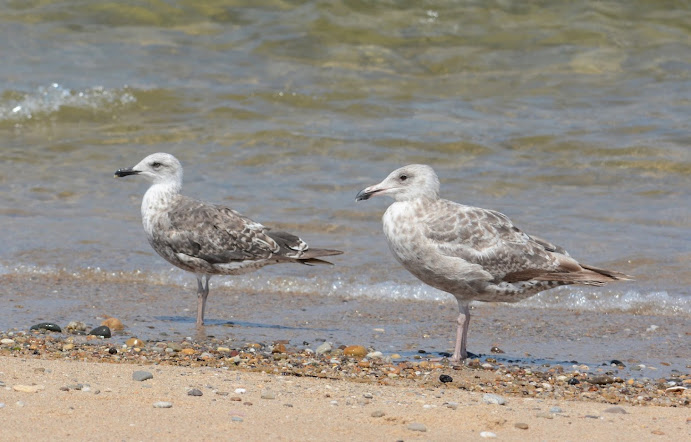
July. Massachusetts. 

Age: Both birds appear to have old, faded juvenile primaries. Note the absence of p6/p7, thus they're actively molting primaries, as well as tertials and wing coverts. This "complete molt" is the 2nd prebasic molt and so we can safely say these birds are in their 2nd (molt) cycle. 

Identification: A nice size comparison of two species frequently seen together on the Atlantic. The individual on the left has a mostly black bill, contrasting white head and solid, dark upperparts. It also appears slimmer and decidedly smaller. It is a rather standard 2nd cycle Lesser Black-backed. The blocky-headed gull on the right, with nondescript upperparts and relatively large paling bill is "just" a Herring Gull. The retained primaries and tertials have bleached significantly, but this is rather typical for a July bird. 

March 2022 Monthly Notables

Sightings:

  • Kamchatka Gull (adult). Fairfield County, Connecticut. 02 March 2022.
  • Glaucous Gull (1st cycle). Sierra County, New Mexico. 02 March 2022.
  • Lesser Black-backed Gull (adult). Clallam County, Washington. 03 March 2022.
  • California Gull (2 adults). Dare County, North Carolina. 04 March 2022.
  • Glaucous-winged Gull (2nd cycle). Flathead County, Montana. 08 March 2022.
  • Great Black-backed Gull (1st cycle). Keith County, Nebraska. 10 March 2022.
  • Common Gull (adult). Washington County, Rhode Island. 11 March 2022.
  • Black-legged Kittiwake (1st cycle). Baldwin County, Alabama. 12 March 2022.
  • Slaty-backed Gull (2nd cycle). Contra County, California. 15 March 2022.
  • Little Gull (adult). Franklin County, Ohio. 15 March 2022.
  • Heermann's Gull (1st cycle). Hopewell County, Virginia. 16 March 2022.
    • Continuing 1st cycle from August 2021.
  • California Gull (1st cycle). Volusia County, Florida. 17 March 2022.
  • Vega Gull (adult). San Mateo County, California. 18 March 2022.
  • Slaty-backed Gull (3rd cycle). Fairfield County, Connecticut. 18 March 2022.
    • 3rd State Record.
  • Short-billed Gull (adult). Fairfield County, Connecticut. 20 March 2022.
    • 2nd State Record. 
  • Slaty-backed Gull (adult). Monroe County, Michigan. 20 March 2022.
  • Slaty-backed Gull (adult). Larimer County, Colorado. 20 March 2022.
    • 3rd? State Record.
  • Sabine's Gull (adult). Clatsop County, Oregon. 23 March 2022.
  • California Gull (adult). Erie County, Pennsylvania. 25 March 2022.
  • Short-billed Gull (adult). Lancaster County, Nebraska. 26 March 2022.
  • Yellow-footed Gull (1st cycle). Clark County, Nevada. 26 March 2022.
    • 2nd State Record. Presumably same individual from Lake Havasu (CA/AZ).
  • Little Gull (adult). Columbia County, Wisconsin. 27 March 2022.
  • Short-billed Gull (1st cycle). Stanley County, South Dakota. 27 March 2022.
  • Black-headed Gull (adult). Clermont County, Ohio. 30 March 2022.
    • 1st state record away from Lake Erie.
  • Heermann's Gull (1st cycle). Baltimore County, Maryland. 31 March 2022.
    • 1ST STATE RECORD. Presumably the Hopewell County, VA bird.

01 March 2022

February 2022 Monthly Notables

Sightings:

  • Slaty-backed Gull (3rd cycle). New York County, New York. 01 February 2022.
    • 1st County Record. Apparently here in late January, first identified as LBBG.
  • Black-legged Kittiwake (1st cycle). Clark County, Nevada. 01 February 2022. 
  • Lesser Black-backed Gull (2nd cycle). San Mateo County, CA. 01 February 2022.
  • Black-legged Kittiwake (1st cycle). Jackson County, Mississippi. 02 February 2022.
  • Black-legged Kittiwake (1st cycle). Mobile County, Alabama. 03 February 2022.
  • Slaty-backed Gull (adult). Los Angeles County, California. 05 February 2022.
  • California Gull (1st cycle). Volusia County, Florida. 06 February 2022.
  • California Gull (adult). Dare County, North Carolina. 06 February 2022.
  • Lesser Black-backed Gull (adult). Clallam County, Washington. 06 February 2022. 
  • Vega Gull (adult). San Mateo County, California. 08 February 2022.
  • Yellow-footed Gull (1st cycle). Mohave County, Arizona. 08 February 2022.
    • Continuing. 
  • Heermann's Gull (3rd cycle). Volusia County, Florida. 08 February 2022.
    • Atlantic Coast Bird.
  • Black-headed Gull (adult). Marion County, Florida. 10 February 2022.
  • Kamchatka Gull (adult). Fairfield County, Connecticut. 10 February 2022.
    • 6th State Record of kamtschatschensis.
  • Glaucous-winged Gull (2nd cycle). Montgomery County, Pennsylvania. 12 February 2022.
    • 1ST STATE RECORD.
  • Heermann's Gull (3rd cycle). New Hanover County, North Carolina. 12 February 2022.
    • 1ST STATE RECORD. Atlantic Coast Bird.
  • Slaty-backed Gull (1st cycle). San Mateo County, California. 14 February 2022.
    • Presumably same bird from December 2021.
  • Vega Gull (1st cycle). Los Angeles County, California. 15 February 2022.
  • Heermann's Gull (3rd cycle). Dare County, North Carolina. 15 February 2022.
    • Atlantic Coast Bird.
  • Common Gull (adult). Washington County, Maine. 17 February 2022.
    • Likely kamtschatschensis, which would constitute a 1st state record for this race.
  • Glaucous-winged Gull (2nd cycle). Bucks County, Pennsylvania. 20 February 2022.
    • Same individual from Montgomery County, PA.
  • Lesser Black-backed Gull (2nd cycle). Benton County, Oregon. 21 February 2022.
  • Slaty-backed Gull (1st cycle). San Mateo County, California. 22 February 2022.
  • Common Gull (adult). Bucks County, Pennsylvania. 27 February 2022.
  • Common Gull (adult). Essex County, Massachusetts. 27 February 2022.
    • Banded as chick in Iceland in 2013. First detected in MA in 2017.
  • Heermann's Gull (3rd cycle). Glynn County, Georgia. 28 February 2022.
    • Atlantic Coast Bird.
  • Heermann's Gull (1st cycle). Hopewell County, Virginia. 28 February 2022.
    • Continuing 1st cycle. 

February 2022 Quiz


London. December.

Age: Identification and aging, once again, go hand-in-hand. This white-headed gull is either a 2nd cycle type (if a three-year gull), or a 3rd cycle type (if a four-year gull).

Identification: The time of year and location set the stage. Immediately we note the small head, thin bill with tapered tip and long narrow wings. The upperparts are not a pale silver-gray, but more of a flat gray (in part due to age and lighting). The lower neck has distinct spotting, and the eye appears disproportionally large. These features all point to the expected Common Gull. The broad white trailing edge to the secondaries abruptly becomes thin at the inner primaries. The two large mirrors on p9-p10 are helpful, and also, the all-white tail and white secondaries tips are expected in 2nd cycle type canus